A clear guide
What is pareidolia?
Pareidolia is the perception of a familiar form—such as a face, animal, or object—in an ambiguous visual pattern. A face in a wall socket or a creature in a cloud are familiar examples.
How pareidolia works
Vision is not a passive recording. The brain organises edges, contrast, orientation, and context into meaningful candidates. When an uncertain pattern resembles something familiar, recognition can arrive before every detail is resolved.
Research on face pareidolia shows that face-selective visual regions respond to illusory faces. One neuroimaging study found an early face-like representation that rapidly shifted toward an ordinary-object representation. That does not mean every kind of pareidolia works identically, but it helps explain why a suggested face can feel immediate.
Faces, animals, and everyday objects
A small number of visual cues can be enough to suggest a familiar subject. The subject is an interpretation, not something physically contained in the pattern, so two people can describe the same cloud differently. Common interpretations include:
- faces suggested by eye-like and mouth-like marks;
- animals suggested by a recognisable head, back, wing, or tail;
- letters, symbols, landscapes, and everyday objects suggested by a contour or texture.
CloudMuse
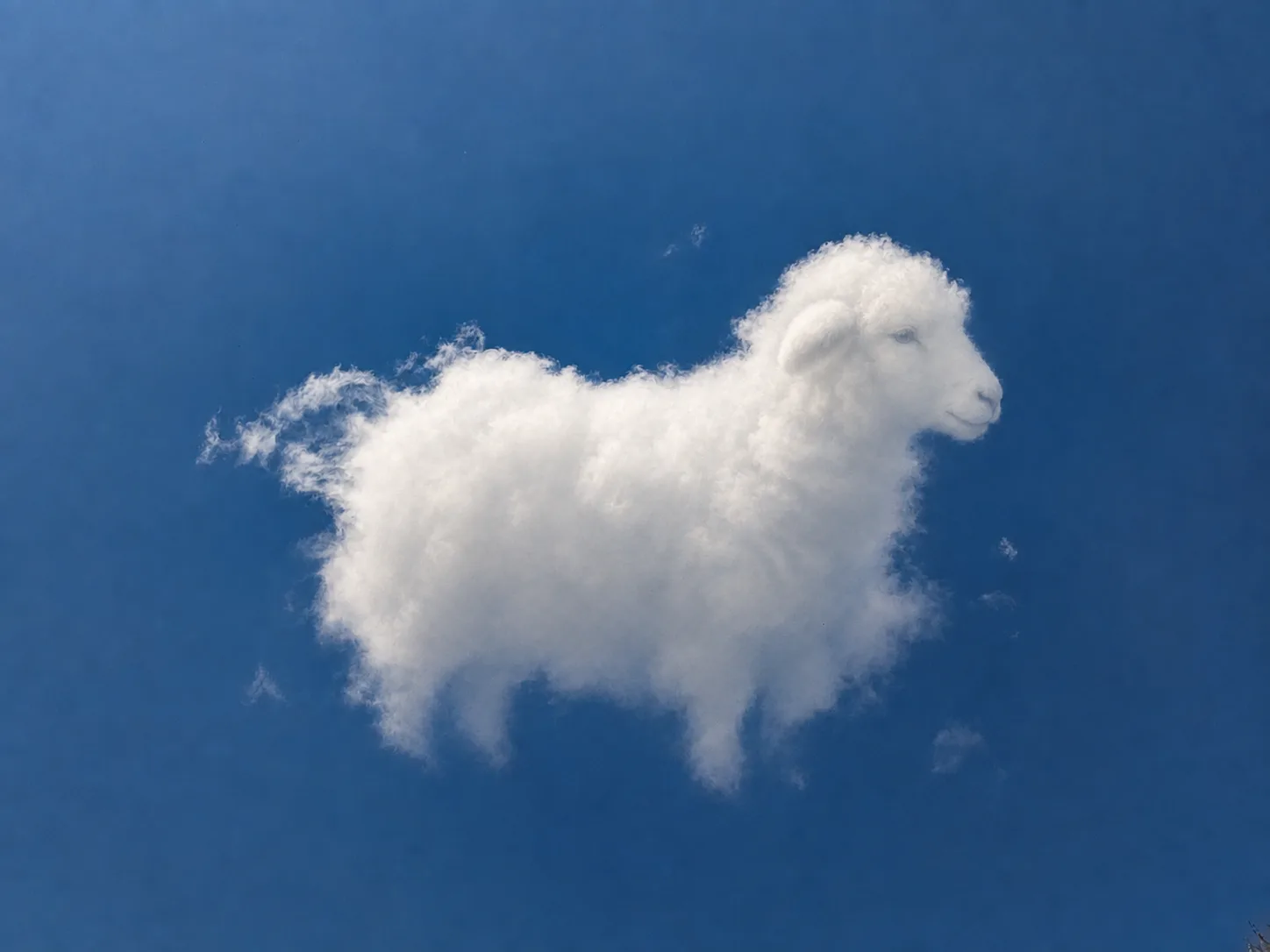
A cloud perceived as a sheep
The observer noticed a sheep in this cloud before using CloudMuse. The reveal makes that personal interpretation easier to share while keeping the original cloud visibly present.

Why clouds invite pareidolia
Clouds have shifting contours, soft depth cues, and incomplete silhouettes. They offer enough structure to suggest a subject while leaving enough ambiguity for imagination. Light, viewing angle, and movement can change an interpretation in seconds.
Cloud pareidolia is the focus of CloudMuse: you identify what the cloud evokes, then the app helps make that vision visible while preserving the source cloud.
Is pareidolia normal?
Seeing an occasional familiar shape in an ambiguous image is a widely described perceptual experience and, by itself, is not a medical diagnosis. The research cited here studies pareidolia in ordinary visual perception.
Context still matters. If any perceptual experience causes distress or affects daily life, a qualified health professional—not a website—can provide appropriate guidance.
Frequently asked questions
What is a simple example of pareidolia?
Seeing a face in the front of a car, an animal in a cloud, or a figure in a rock formation are simple visual examples.
Why do people see faces in things?
Face-like arrangements can quickly engage visual processes specialised for detecting faces, even when the object is not a face.
Is pareidolia only visual?
The term can also be used for familiar patterns perceived in ambiguous sounds, although CloudMuse focuses on visual pareidolia.
Do all people see the same shape?
No. Context, attention, memory, viewpoint, and individual associations can lead people to different interpretations.
How does CloudMuse use pareidolia?
The person decides what they see first. CloudMuse then creates a visual reveal of that interpretation while keeping the original cloud recognisable.